Neural Networking: Making Connections in the Brain, Behavior, and Cognition fields

Date & time: Tuesday, March 31, from 09:30 to 17:30
Location: Academiegebouw, Utrecht
Dear early career researchers in Brain, Cognition, and Behavior,
Young NeurolabNL would like to invite you to our annual spring event. This year, we have prepared a full-day program focused on networking, including a keynote lecture, personal stories, a poster/pitch session, and two parallel workshops.
Registration is free (incl. lunch and borrel)!
Agenda
9:30 – 10:00 – Registration
10:00 – 10:15 – Welcome from Young NeurolabNL (aula)
10:15 – 11:00 – Keynote lecture: Stefan van der Stigchel, Utrecht University: “Taking a popular science approach to the field of attention” (aula)
11:00 – 12:00 – Personal stories with panel discussion (aula)
12:00 – 13:00 – Lunch (Zaal 1636)
12:30 – 14:00 – Poster/networking session (Johanna Westerdijk Room)
13:15 – 14:00 Pitches networking session (Belle van Zuylenzaal)
14:00 – 14:30 – Coffee break (Johanna Westerdijk Room)
14:30 – 16:30 – Workshops in parallel sessions:
(1) “Scientific networking” – Thierry Delatte, Hertz Trainingen (Belle van Zuylenzaal)
(2) “Visual science communication for online networking” – Dr Marta Wronska, Place for Creativity (Kernkampkamer)
16:45 – 17:30 – Best poster/pitch announcement and networking drinks (Johanna Westerdijk Room)
Workshops
(1) “Scientific networking”
(Thierry Delatte, Hertz Trainingen)
Networking has a bad reputation among scientists because they feel that you have to promote yourself or pretend to be interested in order to get something from others. There is also a misconception that it is good to get in touch with as many people as possible. That is not what networking is about. Networking is showing interest in others and their work, looking for common interests and finding out where you can help each other. Networking is investing in relationships without expecting anything in return.
In the networking workshop, we will:
• discuss the do’s and don’ts of networking in academia,
• practise giving short, enthusiastic presentations,
• look for common interests,
• discuss how to prepare for a networking conversation at a conference.
(2) “Visual science communication for online networking”
(Marta Wronska, Ph.D., Place for Creativity)
In the era of budget cuts and overwhelming pressure on academics, networking and collaborating with business and the industry are more important than ever. Communicating your research online via blogs or social media is a great tool to build awareness about your research and trigger interest in your topic. But how to fit it into the busy academic schedule?
This workshop will focus on using hand-drawn visualization techniques to create engaging and accurate social media posts and blogs. We will cover basic research marketing fundamentals, identifying your target audience and their specific needs, speaking the language of your audience, and finding the real-world relevance of your topic. We will learn how to use basic shapes such as squares, circles, and lines to explain your research visually and practical techniques anyone can apply, regardless of artistic background. We will create a simple visualisation to post your research on social media.
(Tuesday March 10, 11:00-13:00) Pre-event online workshop: “Communicating science through visually engaging posters”
(Marta Wronska, Ph.D., Place for Creativity)
Designing a visually appealing and engaging conference poster can be daunting, and the return on investment (interest from peers at the conference) often disappoints. In this workshop, we will cover research marketing fundamentals to boost your poster presentations. We will dive into your target audience’s shoes and their specific needs, learn how to speak the language of your audience, and STRIP down your research to the essence to TEASE your audience. We will learn how to use technology to your advantage, and some hand-drawing visualization techniques to make your research shine.
Speaker information

Dr. Joost Breeksma is a philosopher who conducts qualitative research into the personal experiences of patients undergoing treatments with different psychedelics for severe mental disorders. His aim is to deepen our understanding of the therapeutic mechanisms involved and the role of setting, therapy, and other contextual factors. As project leader of TRIP, he aims to connect all stakeholders involved in research and the therapeutic use of psychedelics—researchers, healthcare providers, patients, regulators, insurers, pharmaceutical organizations, policy makers, politicians, and more—to ensure the safe, ethical, and responsible implementation of psychedelic-assisted therapies in the healthcare ecosystem. Joost is also the executive director of the non-profit OPEN Foundation, where he organizes scientific conferences, expert meetings, collaborative research networks, and more, all with the goal of advancing interdisciplinary research into the (therapeutic applications of) psychedelics. He believes in collaborative, transdisciplinary, critical, and open-minded approaches in science and beyond.

Dr. Thierry Delatte is a certified coach specializing in strategic planning and the supervision of Writing Support Groups. He is a plant biologist and has twenty years of experience as a fundamental researcher. During the event, he will deliver the workshop on Scientific networking.

Prof. dr. Stefan van der Stigchel is Professor of Cognitive Psychology at Utrecht University. He leads the research group AttentionLab, which investigates how attention and visual awareness together shape our perception of the world. Stefan’s research has previously been supported by NWO Veni and Vidi grants. He is currently conducting research on visual working memory, supported by an ERC Consolidator Grant and an NWO VICI grant. In addition to his scientific publications, Stefan is the author of the popular science books Zo werkt Aandacht and Concentratie, and more recently Grip op je aandacht. His books are published internationally, including by MIT Press.

Dr. Lara Wierenga is a neuroscientist and Assistant Professor in the Department of Developmental and Educational Psychology at Leiden University. As founder of the X Lab, she focuses on the intersections of mental health, society and brain development. Lara is the author of the book Atlas van ons Brein (Atlas of our Brain), in which she makes her own research and field of expertise accessible to a wide audience through insightful infographics. In this talk, she will share her experiences in creating Atlas van ons Brein and explain why it is now more important than ever to make science accessible.

Dr. Marta Wronska (Place for Creativity) is a science communication and visual thinking consultant with a PhD from the University of Groningen in the psychology of creative thinking. She helps researchers translate complex science into accessible visual stories, as she deeply believes that the best research deserves to be seen and heard. With 10+ years of academic research on psychological processes that explain creative thinking she brings deep expertise to the challenge of making complex research accessible. For over 8 years, she has been practicing visual thinking in different contexts, creating figures for grant proposals, conference posters, visual summaries from conferences, and quick “Draw My Research” 1:1 sessions. She also draws on her 10+ years of experience as an international professional navigating cross-cultural team dynamics to coach professionals facing communication challenges.
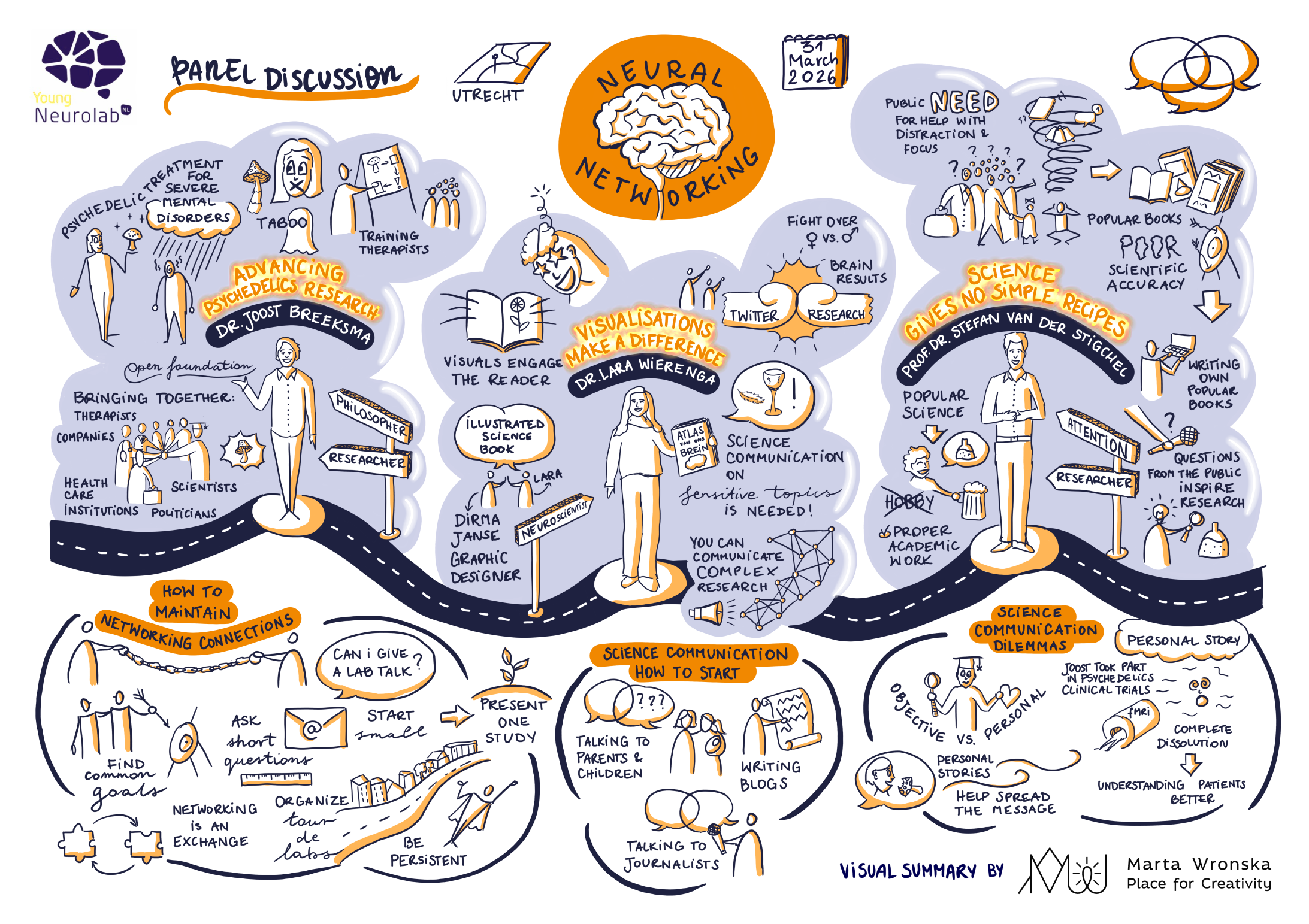
Update: Summary of Panel Discussion
Dr. Marta Wronska has prepared this wonderful visual summary of the panel discussion we had during the event (click on the picture to view it in full size):